Free Speech vs. Platform Liability Debates in the USA
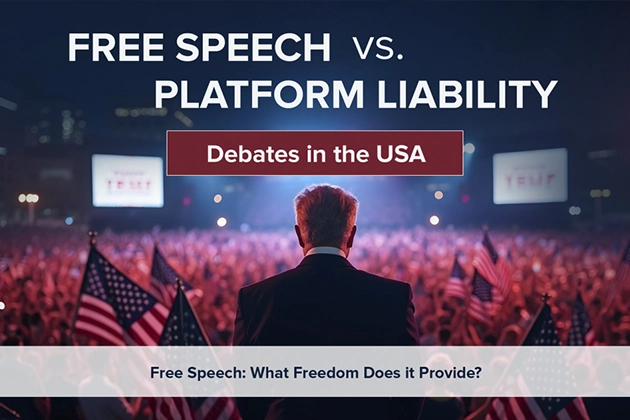
An article of ‘The Centre for International Governance Innovation’ has specified that “In the digital world, few ideas have been as enduring as that of the free and open internet. But in a liberal-democratic society, there's little room for debate once you've pulled the censorship pin on the free-speech grenade.” No matter how controversial the statement might sound, we cannot deny that free speech vs. platform liability debates in the USA are aimed at balancing user freedom with the need to decrease harmful content across social media platforms.
To understand the long-run debates between free speech and platform liability in the digital era would require you to have a fair knowledge about what they are and how they influence social media content generation, use, and regulation.
Free Speech: What Freedom Does it Provide?
According to the United States Courts, freedom of speech encompasses a range of rights, from using offensive words to convey political messages to engaging in symbolic speech. The US Supreme Court often struggled to determine what exactly constitutes protected speech. The First Amendment states that “Congress shall make no law...abridging freedom of speech.” The United States of Courts enlists the rights that Freedom of Speech includes and excludes.
Rights Included in Freedom of Speech
-
The right of students to wear black armbands to school to protest a war.
-
Not to speak the right not to salute the flag.
-
The right to use specific offensive words and phrases to communicate political messages.
-
The right to advertise commercial products and professional services, with some restrictions.
-
The right to contribute money to political campaigns.
-
The right to engage in symbolic speech. For example, burning the flag in protest.
Rights Excluded in Freedom of Speech
-
The right to incite imminent lawless action.
-
The right to burn draft cards as an anti-war protest.
-
The right to make or distribute obscene materials.
-
The right of students to make an obscene speech at a school-sponsored event.
-
The right of students to advocate illegal drug use at a school-sponsored event.
-
The right to permit students to print articles in a school newspaper about the objections against the school administration.
This general view of freedom of speech explains the rights that we must and must not exercise to safeguard their dignity and lawful application across areas. But when it comes to social media content, the scope of freedom of speech goes beyond political activism.
Free Speech and the Regulation of Social Media Content
The concept of free speech on social media has become a controversial issue in the modern-day digital landscape, particularly in light of political events. Although the First Amendment protects individuals from government censorship, it does not extend to private organizations that allow social media platforms to enforce their own content modification policies. This issue has raised concerns about the balance between safeguarding free speech and preventing harmful content. As social media is a tool for both disinformation and activism, it becomes extremely difficult to control the violation and misuse of the rights enshrined in freedom of speech.
Standing at the intersection of free speech and social media regulation, companies are grappling to maintain a balance between the two. The intersection has been complicated by various disinformation campaigns, which have manipulated public opinion and influenced democratic processes. These campaigns have been used vehemently to influence elections and public policy worldwide. Some countries, such as China and North Korea, have banned these platforms altogether, and others have limited users’ speech online. As technology continues to advance, some governments have imposed limits on citizens’ use of social media.
In terms of US Law, Free Speech is protected within limits in the country and is included in the Bill of Rights. Since the First Amendment was adopted, the US Supreme Court has clarified that it refers to all levels of government. The Court has also interpreted speech and press extensively as technology continues to advance, including broadcasting, other forms of expression, and postings on the Internet. However, soon Congress recognized that such protection failed to protect organizations or individuals from the consequences of their speech. The courts have not always been open to some types of expression. This narrow interpretation of the First Amendment started to change in 1920, and since then, the Supreme Court has supported some restrictions. For instance, content on obscenity and child pornography has little or no protection. Apart from that, other low-value forms of speech include fighting words, defamation, threats to commit a crime, and commercial advertising.
Social Media Platform Liability
Social media has become a massive liability for Meta, Google, and other Big Tech platforms. Platform liability in the United States social media is undergoing a major shift, with the recent 2026 court rulings finding platforms liable for, and often settling claims that addictive designs and user-generated content cause harm to minors. AI algorithm liability on social media sites is transitioning from passive immunity to active accountability, with recent legal rulings holding platforms liable for harms caused by recommendation systems, including child exploitation or addiction.
The new regulations treat algorithms as extensions of corporate action, requiring accountability for data privacy, the amplification of harmful content, and algorithmic bias. For instance, if an AI algorithm causes harm, it must be prosecuted through tort liability. Corporate tort liability holds corporations accountable for harmful actions or behavior, even if their actions were not intentionally harmful. However, the primary point of discussion is whether these platforms could be subjected to the right to speech.
Free Speech vs. Platform Liability
Social media platforms are a representation of a significant free speech revolution. As they disseminate vast amounts of information to diverse audiences and enable the expression of opinions, some opinions can be hateful and violent. While AI is essential in combating content-related issues, its application in regulating more contentious areas is complex. AI’s limited ability to understand the nuances of human communication poses a threat to free speech, equality, and access to information. Passive platforms have evolved to become regulators of speech, and hence, the debate continues to persist in line with technological advancement.
As a trusted source of business information, The Silicon Journal safeguards the sharing of authorized information and discourages the spread of misinformation and disinformation.
Related Articles


Recent Articles


Latest Issue